> For the complete documentation index, see [llms.txt](https://committees.docs.intersectmbo.org/llms.txt). Markdown versions of documentation pages are available by appending `.md` to page URLs; this page is available as [Markdown](https://committees.docs.intersectmbo.org/intersect-budget-committee/archive/drep-knowledge-journey/stage-1-introduction-to-the-budget-process/budget-buckets.md).
# Budget Buckets
Budget Buckets
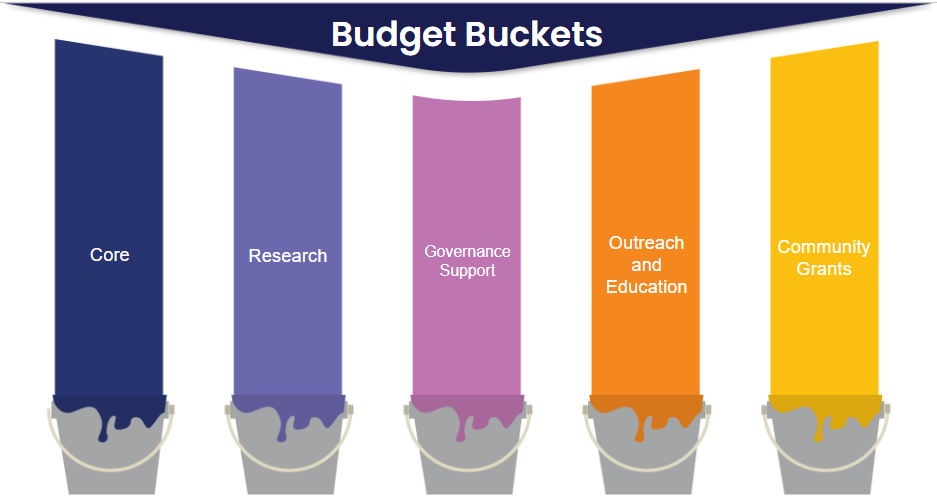
In the Cardano budget process, the budget is divided into five primary "buckets," each with a specific purpose aligned with Cardano’s strategic and operational goals:
1. **Core Development**: Funds essential operations and technical improvements, maintaining and expanding Cardano’s core blockchain features.
2. **Governance Support**: Provides resources for governance structures, including DReps and Constitutional Committee activities, to uphold Cardano's decentralized governance.
3. **Research**: Supports ongoing blockchain research and innovation.
4. **Outreach and Education**: Promotes Cardano through educational programs, community engagement, and global outreach to expand adoption and understanding.
5. **Community Grants**: Allocates funds for community-led projects and initiatives, to foster ecosystem growth through decentralized innovation.
Each bucket is strategically defined to ensure Cardano’s continued development, governance, and community involvement in a balanced and impactful way.
---
# Agent Instructions
This documentation is published with GitBook. GitBook is the documentation platform designed so that both humans and AI agents can read, navigate, and reason over technical content effectively. Learn more at gitbook.com.
## Querying This Documentation
If you need additional information that is not directly available in this page, you can query the documentation dynamically by asking a question.
Perform an HTTP GET request on the following URL with the `ask` and `goal` query parameters:
```
GET https://committees.docs.intersectmbo.org/intersect-budget-committee/archive/drep-knowledge-journey/stage-1-introduction-to-the-budget-process/budget-buckets.md?ask=&goal=
```
`ask` is the immediate question: it should be specific, self-contained, and written in natural language.
`goal` is what the user is ultimately trying to achieve, the reason they need the answer. Sharing it helps GitBook give you a better, more relevant answer. A goal is most helpful when it describes the outcome the user wants rather than restating the question. For example, with `ask=how do I create an API token`, a goal like `build a script that syncs our docs to a CMS` lets GitBook tailor the answer to that use case.
The response will contain a direct answer to the question and relevant excerpts and sources from the documentation.
Use this mechanism when the answer is not explicitly present in the current page, you need clarification or additional context, or you want to retrieve related documentation sections.